
| Volume VI: Issue #12 | |
| In This Edition: | A Word From Soft Touch From the Editor… House Advantage Control… Queen Bee’s Buzz… Today’s Wisdom… Number Control… A Labor of Love… Newsletter Archive Links |
Soft Touch Say’s
Happy Holidays everyone!
As we all take the time to enjoy our holiday season with good cheer and wishes, I would like to take the time to count my blessings and end the year thanking everyone for their continued support.
Whether it was through the workshops or through the website and forum, I am most grateful for the experience we shared in and out of the casinos. The moments were truly gifts to be treasured.
I would like to thank the newsletter readers and web site visitors. Your responses, ideas, answers to Ed’s questions provided to the readership are greatly appreciated. It is great to know that the subscribing membership has quadrupled since March of this year, a blessing confirming our content.
By the way, DiceSetter.com now ranks in the top 1% of all websites on the Internet, thanks to you, our loyal followers. And, it is interesting to note that our traffic statistics indicate a trend that there are more and more new players interested in the game as a whole which is telling me that there are still a lot of people out in the world interested in the game of craps. New shooters-new directions, what another blessing!
And, of course the newsletter wouldn’t be as successful without its contributing authors like the mysterious Mad Professor, Deadcat (my forum moderator), Jeffrey47, Michael Vernon, Dice Coach and Mike in Hawaii. Your contributions throughout this year to Dicesetter.com have made the site tremendously successful. Along with our readership, I look forward to your future contributions, whenever they may appear.
Also, I would love to thank all who participated in the 2006 workshops. I look forward to re-connecting with my associates, The Professor at Playing4keeps/ and Dice Coach at Dicecoach.com/ along with, the community of players next year for more “hands on” training. Establishing a face-to-face, one-on-one connection with all of y’all is important to me. I have quite a few strengths and believe one of them lies in my ability of teaching players how to improve their game. So, I intend to continue the personal work with those I know and those I have yet to meet to help them be the best player they can imagine themselves to be.
I would be remiss if I did not extend a million “thank you’s” to my editor and webmaster, Ed, Dave and their staff. I have been blessed by your support, patience, love and encouragement and it helped me positively weather the ups and downs of making this newsletter and the web site a continued labor of love. I look forward to working with you next year dear friends.
Best wishes to all during this wonderfully magical time of year. Let’s raise our cups to Peace, Love and Craps-Salud! Be good to yourselves, count all the blessings bestowed upon you this year and enjoy the rest of the newsletter.
In gratitude, Soft Touch
PS If you have any suggestions for the new dicesetter.com website or newsletter please send them to me at Ed@dicesetter.com and I’ll have a look and see how we can incorporate them into our future plans.
After getting Dice Setter Newsletter back on-line this year, the crew is settled down for a long winter’s nap. Well, a break anyway. We will be back early January for the next edition. Just to let those of you who send email to ed@dicesetter.com it may take a little bit of time for a response. Chewy is manning the station part-time while the rest of us are away. He is pure tech… no dice.
To all the Forum Members, Dave thought it would be a good idea to tweak some things on the Dice Setter Forum, this being a slower time, and about the only time to do that sort of thing.
So the Dice Setter Forum is temporarily in maintenance mode.
As for me, you may find me on the beach or at Jupiter’s Casino Gold Coast, Surfer’s Paradise, Queensland.
Happy New Year!
Ed
House Advantage Control
By Mike In Hawaii
It has taken a long trip to get to a bottom line with Dice Control. First we had to determine if such a thing could exist. Could it have a physical basis in a learnable skill? We found a promising mechanism in axial control, and a more remote possibility in facial control.
Once a mechanism was available, we could create a spreadsheet that would calculate how that assumed level of control would effect the percentage appearances of the 36 possible dice rolls. From there we had to calculate the effect on the 11 numbers that drive the game of Craps. We even reasoned out how to go from a statement of “I can control the dice one out of X rolls” to facial percentages that would need to be used to simulate that level of dice control.
This finally gives interesting tables and pretty charts showing that indeed the six basic axial control dice sets do indeed change the distribution of numbers in a potentially significant way with levels of dice control that while difficult, are not super human. We had to consider all the physical constraints that construction of each die demanded. And be clear that we cannot “rob Peter” unless we “pay Paul”. We must end up with certain totals right at 100%. If control enhances percentages in one area, it must suppress percentages somewhere else to restore balance.
Finally we came up with a model to convert from assumed dice control to a bottom line. All shooters are random rollers. No one can call with absolute certainty the next roll of the dice. Therefore all participants in a game of Craps will see their results, their winnings and loses vs. sequential rolls as a random walk. A random walk around a baseline.
Since the house has designed the game of Craps to have a house advantage, that is be less than a zero sum, fair bet game, the baseline will slope downwards at the house advantage loss rate. How steep your personal baseline is will depend on what bets you make since in Craps you are faced with some of the lowest and some of the highest house advantages in the casino, all mixed together on the felt. In other words, on the composite house advantage of your betting strategy.
Where true dice control comes in, is its ability to potentially alter the house advantage on specific bets. Any dice control that moves the distribution of the 36 outcomes from flat, all equal at about 2.78% each, will cause the house advantage on all Craps bets to potentially change. Some actually can remain virtually unchanged. Others will be quite sensitive to change.
Here we have a bottom line that we can examine. Finally we have slashed our way through the mathematical undergrowth of the jungle far enough to create a trail from an assumed level of dice control to a “show me the money” type of answer.
The Hardways Set
Let’s look at actual numbers for a classic 1-6 1-6 axial, symmetrical set called the “Hardways Set”. It is so called because when ready to throw, the top, bottom, front and back face pairs all make “hardways”. Specifically, 2-2, 3-3, 4-4, and 5-5. The hard four, hard six, hard eight and hard ten.
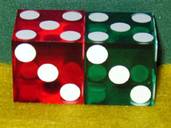
What would this set actually accomplish if one could throw it with high quality dice control? Exactly how would you have to change your betting strategy to compensate for the effect such control would have on the 36 rolls? How would that control percolate down to the bottom line, advantageous changes in the house advantages on various bets, and disadvantageous changes in house advantage on various bets?
This is very critical information! Without it, you are far better off working hard to NOT control the dice, but have them behave in a totally random fashion. Why? When you start messing with the 36 possible results of a throw of the dice, when you move those percentages off a flat line of 2.78% each, you are going to change everything, somehow. Many bets will potentially become considerably worse for the player. If you do not know exactly which ones, you are in big trouble.
At least for the true random roller, the house advantages are well known and easy to calculate. Any betting strategy will have a composite house advantage that is knowable.
You start actually achieving some level of dice control, you give up this information and absolutely MUST get it back.
So let’s look. This set is very well named. We will assume a level of control of one roll in 12. We will assume you can get it to work one out of every 12 tries. This is perhaps possible with a lot of practice, study and coaching. By selecting such a high level of control, we can get a clearer picture of where a given dice set is headed. Which house advantages it is targeting in a positive and negative direction.
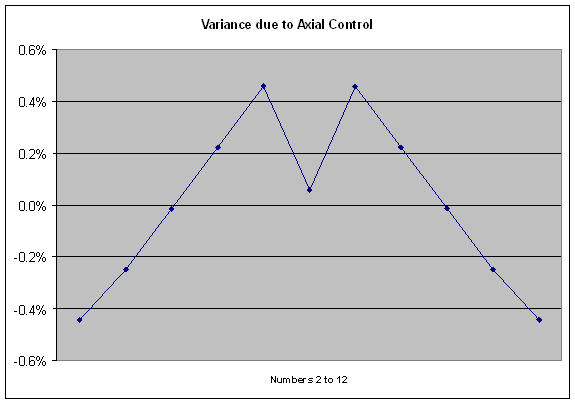
Set up for just axial control, suppressing to some extent (about 8.33%) the appearances of the ones and sixes which we set on the horizontal side to side axis, we discover little effect on the Sevens. Sevens is our heaviest number, it has the greatest mass. It is the hardest number to control.
We do see a nice effect on the lighter numbers, especially the Twos and 12’s. Why? well if either die is controlled and its One does not appear, then there are zero ways to make the sum Two. If either dice is controlled so its Six does not appear, then there are zero ways to make the sum 12. That is why I call these numbers “light”. They have no “backup plan” like Seven does. You take away the One or the Six and Seven still has multiple ways to get created based on Two, Three, Four and Five.
Notice that what we take away from these numbers, we get back in the summed point numbers Six and Eight. Let’s look at the table:
| Group | Result | Random | Absolute | Relative |
| Craps | 9.97% | 11.11% | -1.14% | -11.39% |
| N / C | 2.21 | 2.00 | 10.43% | |
| Wins | 22.03% | 22.22% | -0.19% | -0.87% |
| Sevens | 16.72% | 16.67% | 0.06% | 0.34% |
| Elevens | 5.31% | 5.56% | -0.25% | -4.72% |
| Hardways | 12.05% | 11.11% | 0.94% | 7.83% |
| Two & 12 | 4.67% | 5.56% | -0.89% | -18.97% |
| Set Pt. | 68.00% | 66.67% | 1.99% | 2.99% |
| 6 and 8 | 28.69% | 27.78% | 0.91% | 3.19% |
| 5 and 9 | 22.67% | 22.22% | 0.44% | 1.95% |
| 4 and 10 | 16.64% | 16.67% | -0.03% | -0.17% |
Notice that the biggest hit is focused in two places. First Craps. This makes sense. This set really targets the light numbers Two and 12. It also beats up on the four ways to make Three and 11. As a result, Craps catches the brunt of any control applied to this particular dice set.
True to its name, this set also targets the hardways, causing them to appear more often than they should. Hardways have “low mass”. Only one of the 36 possible results of rolling two dice makes each of the hardways. You mess with the frequency of the face on a given die that contributes to a specific hardway, and you mess with the frequency of the that hardway in a rather focused manner.
What we end up with is a dice set that on the come out roll will suppress immediate losses due to Craps. It will have an increased chance of setting a point. When it does set a point it will tend to set Six and Eight more than other points. It also slightly favors the Five and Nine as points. Since it does not like 11’s, its effect on wins due to Naturals on the come out roll will be diluted, actually pushed negative.
What about the bottom line? The effect on house advantages? What about specific bets on the felt? In the table below, “Random” is what a true random roller has as a house advantage. “Control” is what this assumed level of control with this dice set implies. “Variance” is the absolute change in percentage. “Relative” is the relative change in percentage of house advantage.
| Random | Control | Variance | Relative | |
| Passline | 1.41% | 0.08% | 1.33% | 94.26% |
| Don’t Pass | 1.36% | 2.25% | -0.89% | -65.27% |
| Hard 4 | 11.11% | 3.73% | 7.38% | 66.45% |
| Hard 6 | 9.09% | 3.01% | 6.09% | 66.94% |
| Hard 8 | 9.09% | 3.01% | 6.09% | 66.94% |
| Hard 10 | 11.11% | 3.73% | 7.38% | 66.45% |
| Place 4 | 6.67% | 6.99% | -0.32% | -4.84% |
| PLace 5 | 4.00% | 3.06% | 0.94% | 23.49% |
| Place 6 | 1.52% | -0.04% | 1.56% | 102.76% |
| Place 8 | 1.52% | -0.04% | 1.56% | 102.76% |
| Place 9 | 4.00% | 3.06% | 0.94% | 23.49% |
| Place 10 | 6.67% | 6.99% | -0.32% | -4.84% |
| Any Seven | 16.67% | 16.38% | 0.29% | 1.73% |
| Any Craps | 11.11% | 20.20% | -9.09% | -81.82% |
| Two | 2.78% | 2.33% | 0.44% | 15.95% |
| Three | 5.56% | 5.56% | 0.00% | 0.00% |
| 11 | 5.56% | 5.31% | 0.25% | 4.51% |
| 12 | 2.78% | 2.33% | 0.44% | 15.95% |
Since it also increases the chances of setting and then making a point, especially Sixes and Eights, the house advantage on a pass line bet is down from 1.41% to close to zero, just 0.08%. Since it thumps on Craps and Craps is the wrong bettor’s friend, you can see that Don’t Pass would not be a good bet with this set if control is actually working. House advantage on that bet soars to 2.25%.
Take a hard look at the Place Six and Place Eight bet. They actually go negative by a tiny amount. That means if this were actually working as advertised, the baseline on these bets would be better than square, they would slightly be in favor of the shooter, and of course all of his friends along for the ride.
The Hard Six and the Hard Eight have really been smacked around. Unfortunately those bets start with a whopping 9.09% house advantage. Slicing that to 3% is impressive, but that is still a lot of house advantage.
What about Seven? People are always going on about Sevens. Well betting Big Red is of course donating your money to the “Casino Management Relief Fund”, a non-tax deductible donation. But it does provide a measure of dice control focused on Sevens. It slides a bit in your favor, by a relative 1.73%. But it is still at a whopping “stick’um up” 16.38%. And due to the suppression of Craps, the any Craps bet has taken the lead as the worst bet in the entire Casino! It is now in the House’s favor by 20.20%, having beaten out Big Red for that dubious honor.
As bar graph these deviations it look like this:
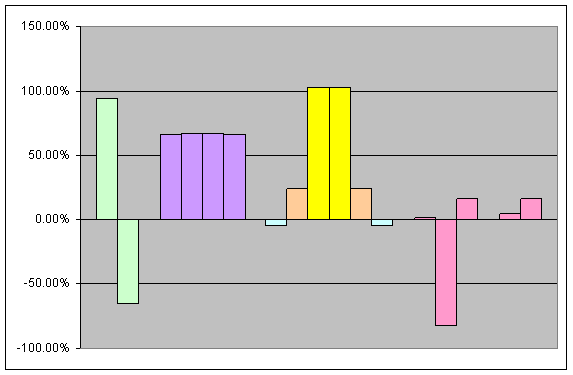
Here we have graphed the exaggerated variations of the effect of this level of assumed axial dice control with the Hardways Set. The two green lines are pass line and don’t pass. The purples are the four hardways, the light blues are the Place Four and Ten, the oranges the Place Five and Nine and the yellows are the Place Six and Eight. The reds are the selected prop bets with the big one heading downwards into your pocket being the Any Craps bet.
So finally, bottom line. If you put in the practice, if you had the professional coaching, if you had dice control, you could mess with the distribution of the percentage appearances of the 36 possible outcomes of a roll of two dice. It takes several steps, permutations if you will, to go from such an assumption to the effect on the house advantages such control might offer.
It is critically important to know exactly where all this is headed because some bets are going to get better for the player/shooter, and some bets are going to get worse. If you do not adapt your betting strategy exactly right, you could work hard, practice a lot and get much better at shooting yourself in the foot.
Copyright © 2006 Mike in Hawaii
As bar graph these deviations it look like this:
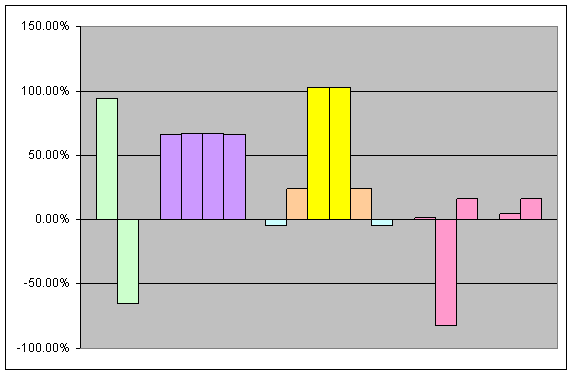
Here we have graphed the exaggerated variations of the effect of this level of assumed axial dice control with the Hardways Set. The two green lines are pass line and don’t pass. The purples are the four hardways, the light blues are the Place Four and Ten, the oranges the Place Five and Nine and the yellows are the Place Six and Eight. The reds are the selected prop bets with the big one heading downwards into your pocket being the Any Craps bet.
So finally, bottom line. If you put in the practice, if you had the professional coaching, if you had dice control, you could mess with the distribution of the percentage appearances of the 36 possible outcomes of a roll of two dice. It takes several steps, permutations if you will, to go from such an assumption to the effect on the house advantages such control might offer.
It is critically important to know exactly where all this is headed because some bets are going to get better for the player/shooter, and some bets are going to get worse. If you do not adapt your betting strategy exactly right, you could work hard, practice a lot and get much better at shooting yourself in the foot.
Copyright © 2006 Mike in Hawaii
Today’s Wisdom:
Strugglers Lack Understanding
Strugglers lack understanding. Sometimes it is just a lack of knowing about the physical plane and how the marketplace works. Usually the struggler will have dropped out something back and be drifting, for he or she is not really prepared to concentrate on life and learn how the world works. He usually can’t be bothered: struggle is easier. It is common for this type to feel that the world owes him a living and he will get upset when circumstances do not necessarily agree with that point of view.
“Life Was Never Meant To Be A Struggle”
Stuart Wilde
Number Control
By Mike In Hawaii
We talked about Dice Control and a believable, learnable mechanism for it, axial control.
But it is very important to remember two things. First that dice control, when it works, directly influences the 36 possible rolls of the pair of dice. Second, Craps is not played with the numbers on the dice, it is played with the sum of the two numbers on the dice. A set of 11 numbers, 11 sums. Dice control only indirectly influences these numbers. To get any beneficial control of the Game of Craps, you must translate dice control into number control.
True there are hop bets that focus on individual pairs of numbers. And there are hardways which are only made one way. But the basic flow of the game moves on the sums, the 11 totals from 2 to 12.
If you look at a roulette wheel casually, you may be impressed with the random arrangement of the numbers. But as you look more closely you discover that it is a wonderfully engineered piece of equipment. Nothing about its layout is random. Dice are the same way. The numbers are placed on each die with some important patterns.
By far the most important pattern is the “opposite sides total Seven” property. Select any side of a true casino die and notice the number on the top face. The bottom face when added to it will total Seven. There are in fact three pairs of numbers, like three sets of twin brothers, not identical twins, but twins. Seven’s compliments of each other.
1 and 6 2 and 5 3 and 4
Each pair makes an “axis”. They are locked together. If one is on top of the die, the other is guaranteed to be on the bottom, not just be one of the other five faces, but exactly the bottom face. No need to turn the die over. If five is on top, two is on the bottom. If not, someone is going to have a very serious talk with security and the boxman!
The six possible numbers on a given die also make a closed set of six faces. This is very important. If you use dice control to suppress one face, that is discourage it from ending up on top, you will encourage the other five faces to end up on top. The odds of the six faces appearing will always total 100%. Normally each will randomly appear on top, in the long run, 1/6th or about 16.67% of the time.
With axial control we are trying to discourage a pair of faces, an axis, from appearing on top. If you use axial control effectively to discourage the 1-6 horizontal axis, then you will encourage the other four faces. With axial control you encourage the other four faces equally. If you think you can control one of those four faces in addition to the pair of horizontal axial faces, that is what I call “Facial Control”.
Even there, the dice construction limits what you can do with facial control. If you encourage five to be on top, the slack is not taken up by the other three non-axial faces. Any control that encourages the five to be on top, encourages the two to be on the bottom by the same amount. It has to. They are twins.
It is much harder to believe in Facial Control as a reality and a learnable skill. Also it is not at all clear that it would even be useful. Why? Because of the construction of a die.
More on that later. Now let’s talk about mass.
Nope, we are not going to church and pray for more Naturals and fewer Seven Outs. I mean the “weight” of each of the 11 numbers in Craps.
The heaviest number is Seven. It can be made six ways. The lightest numbers are two and 12 which can only be made one way each.
2 and 12 = 1
3 and 11 = 2
4 and 10 = 3
5 and 9 = 4
6 and 8 = 5
Seven = 6
Craps is played with these numbers, these sums. Because of the mass of the Seven it is very hard to “control” the number Seven. The fact that what matters is a sum of two dice, and opposite sides of each single die total Seven, conspire against such control. You can have quite nice dice control and not move the relative probability of a Seven appearing by more than a nearly insignificant fraction of a percent. It is a heavy number.
On the other hand, you can rather easily control the two and 12. They are not impacted by the “opposite sides total Seven” mojo, and each is made only one way. Mess with one on either die and you mess with the sum number two. Mess with six on either die and you mess with the sum number 12. Take away the one on either die with axial control and you mess with the three as well. This explains why a 1-6 1-6 axial set is so effective at attacking Craps on the come out roll.
But what about Seven? The 1-6 1-6 suppresses both one and six on both dice when done right. That is two of the ways to make Seven! We are going to suppress Sevens!
Ahhhh, no….
You are left with four faces that are anxious to make Seven. And remember the physics, the reality of how a die is constructed. If you suppress the one and the six, you are going to enhance the other four numbers on that individual die. If the one and the six appear less often, the other four faces are going to appear more often. Seven is so “heavy” it is difficult to undermine it.
The other natural, 11, da Yo, unfortunately is rather light. You mess with the 6 on just one die and you mess with the 11. So if you are using a 1-6 1-6 axial set, you will be discouraging the 11’s to a significant extent.
So what does this all add up to? (Add up is a key phrase, Craps is played with the SUM of two dice). Well a 1-6 1-6 axial set is going to be good at suppressing Craps on the come out roll if thrown with decent axial dice control. Unfortunately it is going to also discourage Natural 11. It is not going to influence Sevens very much, far less than you would hope for.
Remember the percentages on all 36 rolls have to total 100%, so if you discourage any of the 36 possibilities, you are encouraging others. Percentages for all six faces of a single die must total 100% as well. If you are discouraging a face on an individual die, you are encouraging other faces.
Since opposite faces of an individual die add up to Seven, if you are encouraging a given face to appear on the top of a die, you are discouraging its twin, its Seven’s compliment, by an identical amount. In fact, you are encouraging its twin, its Seven’s compliment, to be on the bottom.
The only way to discourage two numbers at once on a single die is to have them on the horizontal axis and somehow (such as by axial control) manage to encourage them to stay there.
Because Craps is played with the sum of the numbers on two dice, some numbers are “heavier” than others and thus harder to influence with any kind of dice control. The most difficult number to have any useful effect on is Big Red himself.
So if the “slack” created by the nice abuse of the Craps numbers with a 1-6 1-6 set has to be made up elsewhere, and it is not showing up in the Seven that much, where is it going? Well first remember that 2, 12, 3 and 11 are “light” numbers. Even though 2, 12, 11 and 3 are rather well influenced, they only represent six of the 36 possibilities. So it is not as much “slack” as it seems. Where the slack does appear is mostly in the Six and Eight and to a lesser extent in the Five and Nine.
What about the other sets? Well there are six basic axial sets. Three of them are “symmetrical”, that is to say they have the same horizontal numbers on both dice. Such as the 1-6 1-6 discussed above, and its two cousins the 2-5 2-5 and the 3-4 3-4.
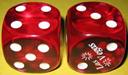
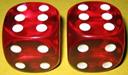
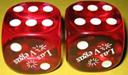
Then there are the mixed sets. The 1-6 2-5, the 2-5 3-4 and the 3-4 1-6 sets. Each has very distinct characteristics. In general the mixed sets generate more anemic results than the symmetrical sets.



How many individual dice sets are there? There is some argument about that. However, the way I calculate them is like this:
Place a single die. You have six numbers you can put on the top face. Keeping the number on the top face the same, there are four ways you can rotate it around its vertical axis to show a different number on the side towards you, what I like to call the “front”. So there are 24 ways to position one die. Six times Four.
There are 24 ways to likewise position the other die. So together there are 24 times 24 or 576 unique dice sets. Now some will argue that the left and right die are not equivalent. So they will double that number. Some people stack them vertically before shooting instead of horizontally. They might argue that these are different than the horizontal equivalent. For me 576 works. The important thing is that they all fall into the six basic families, especially for axial dice control.
It is very likely that what number is on top, bottom, front or back does not matter. Only the two numbers on the left and right sides, the side to side horizontal axis. It certainly speeds up the setting process if you don’t worry about anything else. Also there is little reason to believe that 1-6 1-6 and 1-6 6-1 or 6-1 6-1 or 6-1 1-6 makes any difference at all.
I wrote a program to apply various levels of axial and facial control to all 576 dice sets in parallel just to make sure. Indeed, when they were sorted by implied results, the ones featuring just axial control sorted themselves out into six stacks.
Real experts on dice control can spot defects in a throw that are consistent. Things such as one die yawing, rotating in flight in such a way as to mutate into another set, or one die rotating around its horizontal axis an extra half or quarter turn relative to the other. If such a mutation is consistent, then which face is up or towards you may become important. Of course you have to have developed a proper and consistent throw in the first place.
However you count dice sets, however many you wish to give pet names to and ascribe properties to, all dice sets have to live with the physics and construction of the individual die. Each has to obey the law of 100%. Mass will be conserved. If you suppress a result somewhere, you simultaneously encourage results elsewhere. There is no getting around that. It’s the law.
Frankly, I think it is hard enough just to try to handle the “basics” which alone take a lot of practice. Grip, throw, aim, distance, loft, landing.
What is the point of a dice set when half the time one of them ends up on the floor, or as I saw Tuesday, in somebody’s coffee? (the errant die bounced off his chest and into his cup of coffee under the rail). In hours of watching a number of tables recently, I saw maybe 80% of the rollers “setting the dice”. Of those I saw maybe 5% follow through with a sensible throw.
My personal favorite was the fellow who took about 15 seconds to get the dice arranged just right each time, picked them up, rolled his wrist over, let them drop into his palm, shook them for a while and tossed them hard into the pyramids at the far end of the table rebounding them back far enough to scatter chips on the prop bets.
The greatest roll of all was a shooter who lined his dice up with some care, appearing to almost put any two numbers on top at random, always gripped them the same way, then made a gentle sweeping throw right for the opposite corner, getting a nice landing and light recoil off the pyramid rubber.
He shot for well over 30 minutes. He hit hardways like crazy! Normally I would not bet such a high house advantage bet, but I quickly had $5 on the hard 8 and the hard 10. He would shoot again and again, seemed like he was on hardways half the time. Once when he made a soft six, I replaced the bet late, just getting it tossed onto the table and saying “hard six” in time for them to say “that’s a bet”. Wham. 3-3 landed two seconds later. Again and again he would top it off by making his point. He Crapped out twice and Naturalled twice. When he finally Sevened Out, I looked at my rail and I had tripled my money.
Was he dice setting? Well, he certainly was focused. He was smooth and fluid. He usually landed exactly where he wanted to, gently. He was by the book. He was quick when he got the dice. And he also took care of business. He ended up with a big stack of greens in his rail. Mostly I think we were all just lucky. It was a streak of course.
It is said that Luck favors the Prepared Mind. I have to wonder if in Craps, Luck favors the prepared Shooter.
Copyright © 2006 Mike in Hawaii